Lorries and Co-Op

Monxton Parish Council has recently had two meetings with Co-Op and TVBC/HCC and we are working together to stop the negative impact of lorries through our village.

Various Monxton residents have spoken to lorry drivers who appear to be lost or trying to turn around. This has shown that many suppliers still held the old address for the Co-Op, which mentions Monxton Road and also calls the building a CDC or RDC (Composite or Regional Distribution Centre) and omitted the phrase ‘Andover Business Park’. MPC has reported this to the Co-Op. MPC also suggested that the directions given to drivers were not as clear as they could be and suggested adding photographs of the site itself and the road signs at the relevant exits on the A303.

So MPC has requested that the following is now being implemented as soon as possible:

Co-Operative

  • Issue a statement to all suppliers to strongly remind them to update their databases with the accurate and up to date address for the CDC at the Andover Business Park, mentioning the words ‘Co-Operative’ and ‘Andover Business Park’, and excluding anything saying Monxton.
  • Create new directions for HGV drivers which will include photos of the Co-Op CDC, and road signs on the approach of the slip roads and roundabout, and be easily understandable with fewer language barriers.

Goodmans

  • To improve the signs at the entrance to and around the Andover Business Park

TVBC/HCC

  • To improve the road signs and road markings leading to the Andover Business Park, and discouraging routes down Monxton Road
  • Add a new sign at the top of the west-bound slip road showing Monxton to left, Business Park straight on, and town centre to the right (or similar) and road markings
  • Add Andover Business Park signs in Collingbourne Ducis to route via Tidworth & A303
  • Ensure ABP is well signed from the east-bound A303, and ensure exit at prior junctions is dissuaded (so no routing via E. Cholderton, Quarley or Amport)
  • Ensure all the approach roads from the A303/A343 etc that could possibly pass through Monxton have the correct signs to dissuade HGVs
  • Add to the ‘No HGV’ signs leading down towards Monxton, possibly at the roundabout by the Army HQ
  • Move the ‘No HGV’ sign currently situated after the railway bridge to BEFORE the bridge and traffic lights

Neighbourhood Watch Alert – December

Summary of reported rural crime in north and east Hampshire
Burglaries to non-dwelling premises are, again, the most reported incidents in the rural areas of north and east Hampshire. These incidents have been reported across the north of the county, but the areas that have seen most of these offences are the rural areas around Basingstoke, Andover and Winchester. Power tools have mainly been targeted together with off-road vehicles. In addition there has been an increase in thefts from stables including horse tack and rugs.

Telephone scams continue to be a problem. Hampshire Trading Standards Service publish information on these, including prize wins, tax rebates and loan scams. For further advice or to report a scam contact:
Citizens Advice Consumer Helpline on 08454 04 05 06.

Advice from the Police for Christmas
PCSO David Trowbridge and the Stockbridge/Andover Rural Safer Neighbourhoods Team offer the following tips for Christmas:

Dwelling Burglary

  • Don’t leave Christmas presents under the tree in view of a window
  • Make sure windows and doors are locked every time you leave the house
  • Avoid leaving tools and ladders lying around that could assist someone to get into your home
  • When you go out at night make it appear that someone is home. Draw the curtains and leave a light on. Always use a timer switch to put on a lamp or radio.

Vehicle crime

  • Before you leave your car, ensure all windows and doors are closed and locked
  • Avoid leaving your purchases and presents in your vehicle. If you must, make sure they are not on display. Rather store them in the boot and make sure the car is locked
  • Always lock your bike. Use a D lock and make the locked bike difficult to manoeuvre by keep any gaps between the lock and bike frame small.

Online shopping

  • When online shopping ensure you go to the official websites and have adequate anti-virus software, especially when purchasing expensive items.

Personal safety

  • Never leave a bag unattended in a trolley, even if for a couple of seconds
  • Keep wallets in an inside pocket and bags closed
    and out of sight from potential pick-pockets
  • Keep your PIN number confidential and when entering your PIN number at a terminal ensure no one can see you enter it.

Property registration

  • If you are buying or receiving valuable gifts such as bikes, mobiles or electrical items register them for free at www.immobilise.com. In doing so you will assist the police in returning your property should it be lost or stolen.

Have a Happy, Safe and Secure Christmas!

Chimney Fires – A Warning!

From Hampshire Fire & Rescue Service HQ, Eastleigh, Hampshire, SO50 9SJ
Tel: 023 8064 4000 

As a member of Hampshire’s Fire Authority, I am writing to raise your awareness of the devastation which may be caused by chimney fires within the home and to share some useful safety information for communities, as we go through the winter months..

In recent years we in Hampshire have seen many fires in homes which started in chimneys. Whilst we continue to successfully reduce the number of fires across Hampshire, recent years have seen an increase in chimney fires.

There are some specific actions that home owners can take to prevent these fires and I would ask that you bring to the attention of residents within your area:

  • Chimneys should be examined regularly. Fire can spread from within the chimney through worn brick jointing
  • Chimneys should be lined, especially in older properties and definitely in ALL thatch properties
  • Chimneys should be swept at the start of the burning season and then:
    • Once per year for smokeless fuel and oil
    • Twice a year for coal fires
    • Every three months for wood burning fires
    • Burning unseasoned wood will create greater soot and tar build up and should not be used or chimneys swept more often

We saw some devastating fires in thatch cottages last year.  All of these fires are believed to have started within chimneys.  Please encourage residents living in thatch buildings to have their chimney inspected by a qualified professional and always follow the guidance above.

For more information on chimney safety please go to http://www.hantsfire.gov.uk/yoursafety/athome/preventionathome/chimneyfires.htm

In all cases, householders should follow the basic principles of keeping safe from fire within the home.  This includes:

  • Always having working smoke detectors within the home – one on each level as a minimum;
  • Think about and practise an emergency evacuation plan and ensure everyone within the house knows what to do in a fire;
  • Reduce fire hazards within the home, such as ensuring all electrical equipment is in good order and sockets not overloaded, naked flames such as fires and candles are extinguished fully before going to bed and smoking is done in a safe place – discarding used cigarettes in a safe place.

More home safety information is available at http://www.hantsfire.gov.uk/yoursafety/athome/preventionathome.htm

As the weather turns colder for the winter, please do also ensure you and your community are prepared.  Hampshire Fire and Rescue Service leads the work of the Hampshire and IOW Local Resilience Forum in preparing for emergencies.  The following web page has more information how you can help your local community plan for emergencies including the colder weather http://www3.hants.gov.uk/localresilienceforum.htm.  In all cases please ensure the elderly and those more vulnerable to the cold and adverse weather are considered by the community.

Please help us to keep our local communities safe this winter.

Yours Faithfully

Keith Chapman

Lost lorry – again

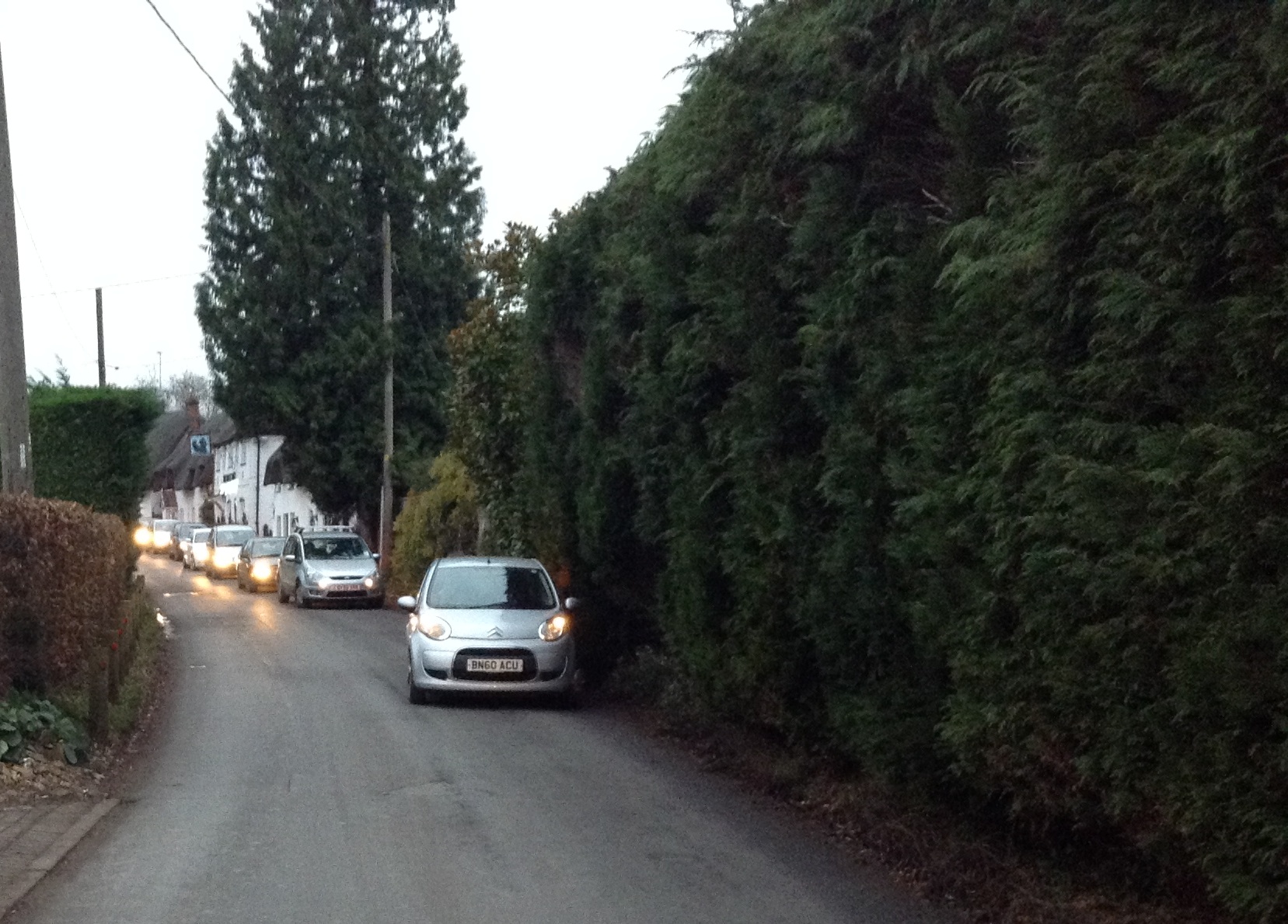
Apparently there was a bit of a language problem (Romanian) but the resident was left with impression that they were looking for the Business Park. It appears to be yet another case of a driver blindly following satnav. 

Romanian lorry apparently heading for the Business Park

Romanian lorry apparently heading for the Business Park

Queued traffic waiting for the lorry to turn around

Queued traffic waiting for the lorry to turn around

Top Tips for moving to the Country

This article appeared as a blog recently about a village in Oxfordshire and should raise a wry smile among those with a sense of humour! For the full article (and some hilarious comments afterwards) click the link here

These days many wealthy city folk are moving to the country. Fair play and good luck.

However, it is an unfortunate fact that many find it hard to assimilate. One of the major reasons for this is the actual countryside is a place where people live and work, not the large leisure park most city people have experienced thus far. Thus the reality is not always what our new neighbours expected to find and, often, they don’t like it as much as they thought they would.

In the spirit of public service, then, here is your handy print-out-and-keep guide to a comfortable new life in the sticks.

  1. The Roads: They are covered in crap. This is a function of drainage ditches being full, of animals on the roads and of large agricultural machinery dropping muck everywhere. This is fine. It is not “a matter for the Parish Council”.
  2. The Parish Council: This will usually be made up of folk who’ve lived in the village for years and also some newer blood. That’s a good thing. It is not a replacement for your Kensington bridge club, or meeting your girlfriends in Harrods, and there is no need for you to join it and try to change everything in order to fill your long afternoons. Unbelievably, we’ve managed so far without you for more than 500 years!.
  3. The Village Pub: A fine and wonderful place which is to be treasured and used. The best thing about it is it’s a real leveller – doesn’t matter who you are, you’ll be judged on how you treat others and nothing else. If you’ve got anything about you, you’ll come to love this about it above all else. On which note, then, please don’t come in and grumble about dogs running around, or about the fact you can’t get St Tropez scallops fried in yak’s butter at 4.30pm or that they may not be able to make you a Brandy Alexander. Also, best not to only come in twice a year, the second occasion being Christmas when you address the landlord like an old friend and loudly call him by his Christian name to impress your friends visiting from Hampstead.
  4. Animals: There are loads, and we kill and eat quite a lot of them. Many are quite noisy, especially cockerels. This is also not “a matter for the Parish Council”. Equally, some are a problem and will be killed by your fellow inhabitants from time to time; others will be killed by each other or by cars. There is not a “little man” who comes along to pick them up. Just drive around them.  Finally on this one, please don’t feed the foxes. They’re not “cute” and they kill all our chickens. This makes us all quite angry.
  5. Your New Dog: Obviously you will have bought a pedigree mutt to go with your new house. Enjoy. However, it’s worth taking the time and making the effort to train it properly so it doesn’t chase sheep or deer, or dive in to areas of nesting pheasants. In the north of the country somebody is likely to shoot it for chasing the former, in the south for chasing or doing the latter. Despite having a Kennel Club name longer than most people’s address, your dog will still be turned inside out by a hand-loaded .243 cartridge. If it’s a gun dog and you intend to work it there’s no need to pay someone £3000 to train it for you. Ours are all rubbish too.
  6. Your New Gun and Togs: Over the years you’ve enjoyed a bit of corporate shooting, and good for you. However, you now have a bit of an issue. Your £18,000 English side-by-side and the £7,000 worth of kit you bought from William Evans on St James’s mean you really need to be able to hit a cow’s arse (NB: cow – large bovine animal found in fields and, occasionally, running down the road for no obvious reason) with a banjo.  Actually nobody cares if you’re rubbish, so long as you can laugh at yourself and take a bit of ribbing, so pop the expensive stuff away and go and buy a working gun whilst you get your eye in.
  7. Your Trousers: Those yellow or blue cords from Oliver Brown on Sloane Street don’t make you look like landed gentry, they make you look like a derivatives trader on a long weekend away. Just don’t.
  8. Your New Community: A village is just like a city, only smaller and therefore more intimate. That means it’s made up of people from all sorts of backgrounds. This is a good thing. If you take the time to get to know them you’ll be pleasantly surprised by the breadth of experiences and knowledge. Lamenting loudly that nobody you now know has been to  see the Chuck Close at Tate Modern is not the best way to achieve this. Nor is making rude assumptions about them and living behind your closed front door all week until the next set of visitors from London arrive for the weekend. You’re missing the best bit of being here, the people.
  9. Your Nickname: Everyone in the village will have a nickname. Most are well meant, if a little brusque. When you discover yours is “Honking Giles” don’t move house, it’s a sign of acceptance. It’s the people without one who need to worry.
  10. Finally: None of the above points apply to villages like the one illustrated here (in Oxfordshire) where the TTP (Twat Tipping Point) has already been reached.  Most of these are in the Cotswolds and are now, basically, London-in-the-Dale. Here you can behave like as much of a narrow-minded, braying bell-end as you like and you’ll receive a warm welcome from your fellow pillocks, and Kate Moss. If points 1-9 above alarm you, this is your solution; if not, we’d love to see you in the actual countryside.